
Low Mortality if more than 20 ng of Vitamin D (UK Biobank)
Vitamin D Status and Risk of All-Cause and Cause-Specific Mortality in a Large Cohort: Results From the UK Biobank
J Clin Endocrinol Metab . 2020 Oct 1;105(10):dgaa432. doi: 10.1210/clinem/dgaa432.
Xikang Fan 1 , Jiayu Wang 1 , Mingyang Song 2 3 4 , Edward L Giovannucci 2 3 5 , Hongxia Ma 1 6 7 , Guangfu Jin 1 6 7 , Zhibin Hu 1 6 7 , Hongbing Shen 1 7 , Dong Hang 1 7
Context: Although an inverse association between vitamin D status and mortality has been reported in observational studies, the precise association shape and optimal vitamin D status remain undetermined.
Objective: To investigate the association between vitamin D status and risk of all-cause and cause-specific mortality and estimate optimal serum 25-hydroxyvitamin D [25(OH)D] concentrations.
Design: Prospective cohort study.
Setting: UK Biobank.
Participants: 365,530 participants who had serum 25(OH)D measurements and no history of cardiovascular disease (CVD), cancer, or diabetes at baseline (2006-2010).
Main outcome measures: All-cause and cause-specific mortality.
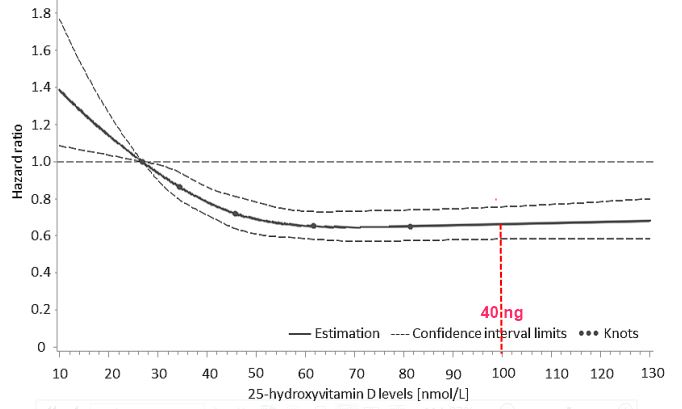
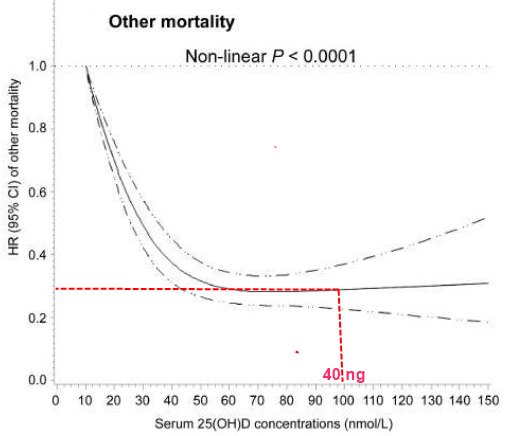
Results: During a median follow-up of 8.9 (interquartile range: 8.3-9.5) years, 10,175 deaths occurred, including 1,841 (18.1%) due to CVD and 5,737 (56.4%) due to cancer. The multivariate analyses revealed nonlinear inverse associations, with a decrease in mortality risk appearing to level off at 60 nmol/L of 25(OH)D for all-cause and CVD deaths and at 45 nmol/L for cancer deaths.
Compared to participants with 25(OH)D concentrations below the cutoffs, those with higher concentrations had a
17% lower risk for all-cause mortality (hazard ratio [HR]: 0.83, 95% confidence interval [CI]: 0.79-0.86), (24 ng)
23% lower risk for CVD mortality (HR: 0.77, 95% CI: 0.68-0.86), (24 ng)
11% lower risk for cancer mortality (HR: 0.89, 95% CI: 0.84-0.95). (18 ng)
Conclusions: Higher 25(OH)D concentrations are nonlinearly associated with lower risk of all-cause, CVD, and cancer mortality. The thresholds of 45 to 60 nmol/L might represent an intervention target to reduce the overall risk of premature death, which needs further confirmation in large clinical trials.
📄 PDF in English 📄 PDF in Chinese (Google Translate)
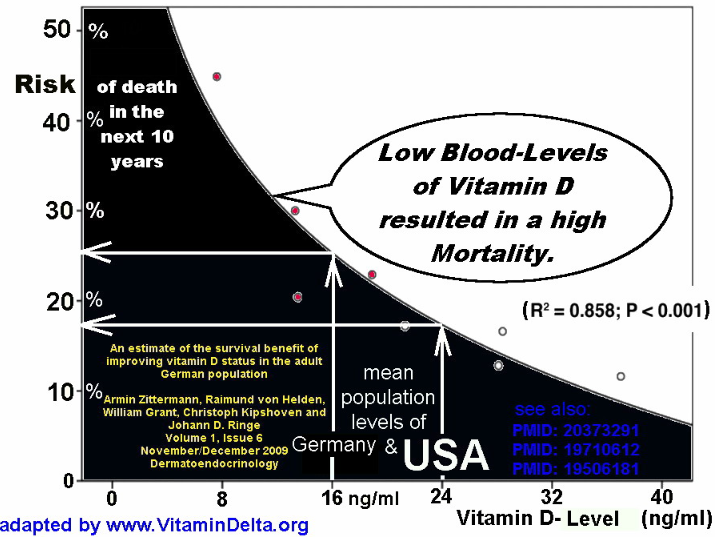
VitaminDWiki - Mortality and vitamin D – great chart
VitaminDWiki - Mortality contains
{include}
Mortality and Virus studies
This list is automatically updated
{category}
38 Google Scholar citations of this study as of Aug 2022
Circulating 25-hydroxy-vitamin D and the risk of cardiovascular diseases. Systematic review and meta-analysis of prospective cohort studies- November 2021 https://doi.org/10.1016/j.numecd.2021.09.003
Calcifediol (25OH Vitamin D3) Deficiency: A Risk Factor from Early to Old Age - March 2022 https://doi.org/10.3390/nu14061168 FREE PDF
Serum 25-hydroxyvitamin D, frailty, and mortality among the Chinese oldest old: Results from the CLHLS study- August 2021 https://doi.org/10.1016/j.numecd.2021.05.033
Gene-Environment Interactions in Vitamin D Status and Sun Exposure: A Systematic Review with Recommendations for Future Research -June 2022 https://doi.org/10.3390/nu14132735 - FREE PDF
Citations that included COVID in their title
Vitamin D3 for reducing mortality from cancer and other outcomes before, during and beyond the COVID-19 pandemic: A plea for harvesting low-hanging fruit - July 2022 https://doi.org/10.1002/cac2.12328 FREE PDF
Vitamin D and COVID-19 —Revisited - July 2022 https://doi.org/10.1111/joim.13536 FREE PDF
Vitamin D and COVID-19: evidence and recommendations for supplementation December 2020 https://doi.org/10.1098/rsos.201912 FREE PDF
Low serum 25-hydroxyvitamin D (25[OH]D) levels in patients hospitalized with COVID-19 are associated with greater disease severity - . 2020 Nov; https://doi.org/10.1111/cen.14310.FREE PDF
New Roles for Vitamin D Superagonists: From COVID to Cancer - March 2021 https://doi.org/10.3389/fendo.2021.644298 FREE PDF